
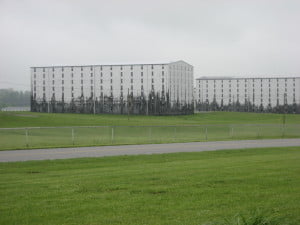
The buildings of bourbon distilleries are often covered with black stain. At first glance, the stain appears to be a charring of the buildings’ surfaces, but in reality, the blackening is growth of the Baudoinia compniacensis fungus, which germinates on ethanol that evaporates into the air during the bourbon aging process. Although scientists only identified Baudoinia in 2007, distillers have observed the blackening of their facilities for centuries. Not surprisingly, Baudoinia also affects the area around distilleries causing similar blackening of cars, sides of houses, and other surfaces.
In 2012, after being fed up of this blackening and allegedly never knowing about the existence of Baudoinia, home and business owners near bourbon distilleries in Kentucky filed class action suits in state and federal courts against the producers of Jim Beam, Woodford Reserve, Bulleit, Elijah Craig, and Buffalo Trace. The plaintiffs allege a number of tortious claims related to purported damage to their real and personal property. They say that the accumulation of Baudoinia causes early weathering of surfaces and requires costly and constant cleaning.
Specifically, the plaintiffs accuse the producers of negligence in causing the accumulation of Baudoinia by not suppressing the ethanol that escapes from their production operations. They also claim that the fungal accumulation is a nuisance and a trespass on their property. For their losses, they demand money damages and injunctive relief in the form of the producers installing ethanol-capturing technology at their facilities.
The defendant producers emphatically deny the plaintiffs’ accusations and claim that Baudoinia is a naturally occurring fungus found in a variety of environments and not just areas near distilleries. The cases are still pending, but they raise several business questions.
- Are these valid claims?
- Should bourbon producers just ignore these suits or take proactive steps to install technology that would limit the release of ethanol?
- Does this technology even prevent the accumulation of Baudoinia?
- Would this technology alter the bourbon’s flavor?
Although many discount these suits as frivolous, the plaintiffs’ claims have survived motions to dismiss, so bourbon producers must carefully examine these questions for the benefit of their business and profitability.
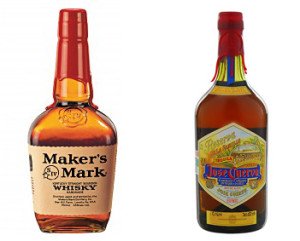
Consumers often buy spirits because of bottle aesthetics. Although the number of spirits producers is small, the sheer number of brands that they produce can overwhelm a normal consumer at a liquor store. Without having tried the spirit or received a recommendation, the consumer has no other criteria for buying except for the brand name, label information, and bottle design. Thus, spirits producers often seek to protect design features of their brands’ bottles.
In the bourbon industry, red wax covering the cap of the bottle is associated with the iconic Maker’s Mark bourbon. Maker’s Mark has held a trademark for its dripping wax bottle element since 1985. In 2003, it sought to enforce its trademark when it sued Jose Cuervo for selling its “Reserva de la Familia” tequila in bottles with dripping red wax, alleging trademark infringement. Although Cuervo discontinued its use of dripping red wax, it counterclaimed by asking for cancellation of Maker’s Mark trademark. Finally, in 2012, the United States Court of Appeals for the Sixth Circuit resolved the dispute by agreeing with the lower court that Maker’s Mark trademark is due protection and that Cuervo had infringed the trademark.
The dripping red wax is not functional because competitors would not have difficulty designing around the mark or competing in the market with an enforceable trademark like this one. Therefore, the dripping red wax is deserving trademark protection. Further, there was a likelihood of confusion between Maker’s Mark and Reserva de la Familia largely because of the “extreme” strength of the trademark and the similarity of the dripping waxes. Thus, this likelihood meant that Cuervo infringed on Maker’s Mark valid trademark, its “signature trade dress element.”
This ruling showed that spirits producers can validly register trademarks on bottle design elements important to the spirit’s reputation, and protect these trademarks in courts. Other producers should follow Maker’s Mark lead in recognizing that bottle design can enhance its brand image and influence consumer buying decisions by registering trademarks on these design elements as quickly as possible and not being afraid to enforce these trademarks in courts.

The world’s insatiable desire for bourbon was on full display last month when Beam Inc., the parent company of major bourbon brands Jim Beam and Maker’s Mark, announced that it was being acquired by Suntory Holdings Ltd., a premium Japanese spirit and beverage company, for $16 billion including the assumption of debt. Suntory, which produces Japanese whiskey (e.g., Yamazaki), Scotch whiskey (e.g., Bowmore), and beer (e.g., Malt’s), will pay $83.50 a share for Beam, which besides bourbon also produces Scotch whiskey (e.g., Laphroaig), Irish whiskey (e.g., Connemara), Canadian whiskey (e.g., Canadian Club), and other spirits (e.g., gin, tequila). The amount per share represents a premium of 25% over Beam’s closing price the business day before the merger announcement. Driven by American popularity of and increasing worldwide appetite for bourbon, Suntory is aiming to be a global spirits powerhouse transforming its business outside Japan and into large (e.g., U.S.) and emerging (e.g., Brazil, India) economies. With the acquisition’s closing, which is expected in the second quarter pending regulatory and shareholder approval, the combined companies will be the third largest spirits company in the world behind Diageo and Pernod Ricard.
Although the foreign acquisition of a company known for its quintessentially “American” whiskeys is divisive, the American public should not be worried about Beam’s products or lost American jobs. First, as documented in the first post, bourbon must be produced exclusively in the U.S. for it to be legally labeled as a bourbon; thus, Beam’s bourbons will remain American-made and not outsourced. Second, Americans should be aware that foreign companies already own many other well-known bourbon brands, including Four Roses (Japan) and Wild Turkey (Italy). Third, if these other brands are to serve as examples, foreign investment will raise global sales of Beam’s brands and therefore, create more jobs when the foreign parent builds more infrastructure to meet the growing demand. Fourth, Suntory and Beam already work together and thus have a familiar relationship distributing each other’s products in different parts of Asia. Lastly, Beam’s management will remain in place, so Beam will be business as usual in its Illinois headquarters.
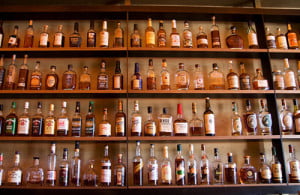
Popularized by the highly desired Pappy Van Winkle and driven by iconic brands (Evan Williams, Four Roses, Jim Beam, Maker’s Mark, Wild Turkey, and Woodford Reserve), the bourbon industry has been booming both domestically and internationally. The spirit generated $4.5 billion in retail sales in 2011 and its production has increased more than 50% in the last 10 years to meet the high demand in the United States and countries like Australia, Canada, and Japan. The resurgence of bourbon has also increased tourism in Kentucky, home to 95% of today’s bourbon production. In the last five years, nearly 2 million people have visited the distilleries on the Kentucky Bourbon Trail. Even though the world has been embracing bourbon, confusion exists regarding what bourbon legally is and its relationship to whiskey.
The United States government has labeling rules defining bourbon made for American consumption. According to the Standards of Identity for Distilled Spirits (27 C.F.R. § 5.22):
- Bourbon is a type of whiskey produced exclusively in the United States. It does not have to be made in Kentucky to be bourbon.
- Bourbon is produced from a fermented mash of not less than 51% corn. Usually, the other two grains in a bourbon’s mashbill are barley and wheat; or barley and rye.
- Bourbon is distilled up to 160 proof, or 80% alcohol by volume (ABV).
- Bourbon enters barrels for aging at no more than 125 proof, or 62.5% ABV.
- Bourbon is aged in new charred-oak barrels. The char adds caramelized sugars that gives bourbon its distinctive flavor.
- Bourbon is bottled at no less than 80 proof, or 40% ABV.
Many bourbons in the retail market have the term, “straight bourbon,” on their labels. To be “straight bourbon,” the bourbon must also meet the following requirements:
- Aged for no less than 2 years. If aged for less than 4 years, it must carry an age statement of the youngest whiskey in the bottle. Any bourbon without an age statement has been aged for at least 4 years.
- Does not contain coloring, flavoring, or other spirits.
- Produced in the same state. The term does not imply that the bourbon is from a single barrel, small batch, or even from the same distillery.

Follow Me!