
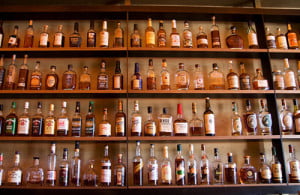
Popularized by the highly desired Pappy Van Winkle and driven by iconic brands (Evan Williams, Four Roses, Jim Beam, Maker’s Mark, Wild Turkey, and Woodford Reserve), the bourbon industry has been booming both domestically and internationally. The spirit generated $4.5 billion in retail sales in 2011 and its production has increased more than 50% in the last 10 years to meet the high demand in the United States and countries like Australia, Canada, and Japan. The resurgence of bourbon has also increased tourism in Kentucky, home to 95% of today’s bourbon production. In the last five years, nearly 2 million people have visited the distilleries on the Kentucky Bourbon Trail. Even though the world has been embracing bourbon, confusion exists regarding what bourbon legally is and its relationship to whiskey.
The United States government has labeling rules defining bourbon made for American consumption. According to the Standards of Identity for Distilled Spirits (27 C.F.R. § 5.22):
- Bourbon is a type of whiskey produced exclusively in the United States. It does not have to be made in Kentucky to be bourbon.
- Bourbon is produced from a fermented mash of not less than 51% corn. Usually, the other two grains in a bourbon’s mashbill are barley and wheat; or barley and rye.
- Bourbon is distilled up to 160 proof, or 80% alcohol by volume (ABV).
- Bourbon enters barrels for aging at no more than 125 proof, or 62.5% ABV.
- Bourbon is aged in new charred-oak barrels. The char adds caramelized sugars that gives bourbon its distinctive flavor.
- Bourbon is bottled at no less than 80 proof, or 40% ABV.
Many bourbons in the retail market have the term, “straight bourbon,” on their labels. To be “straight bourbon,” the bourbon must also meet the following requirements:
- Aged for no less than 2 years. If aged for less than 4 years, it must carry an age statement of the youngest whiskey in the bottle. Any bourbon without an age statement has been aged for at least 4 years.
- Does not contain coloring, flavoring, or other spirits.
- Produced in the same state. The term does not imply that the bourbon is from a single barrel, small batch, or even from the same distillery.


